Out-of-class requests are one of those school operations that hide in plain sight. Every school has students leaving classrooms throughout the day — for the bathroom, sick bay, the office or the counsellor. But few schools have a consistent shared record of those requests. This guide is for principals who want to understand the landscape, the risks and the options.
Why out-of-class records matter more than you think
On any given day, a secondary school of 1,000 students may process hundreds of out-of-class requests. Each request is a moment where:
- A teacher has approved a student to leave class
- The school's duty-of-care process may need a contemporaneous record
- A later review may need the issuing teacher, selected destination and associated times
Approaches range from verbal permission and paper sheets to digital passes. Each creates different trade-offs in access, consistency, search and shared review of open records.
The three approaches to out-of-class records
Every Australian school uses one of three approaches. Here's an honest assessment of each.
1. No shared record (the default)
With verbal permission, a teacher approves the request but no shared pass record is created. The school should assess whether that process supplies the information its policies require.
2. Paper sign-out sheets
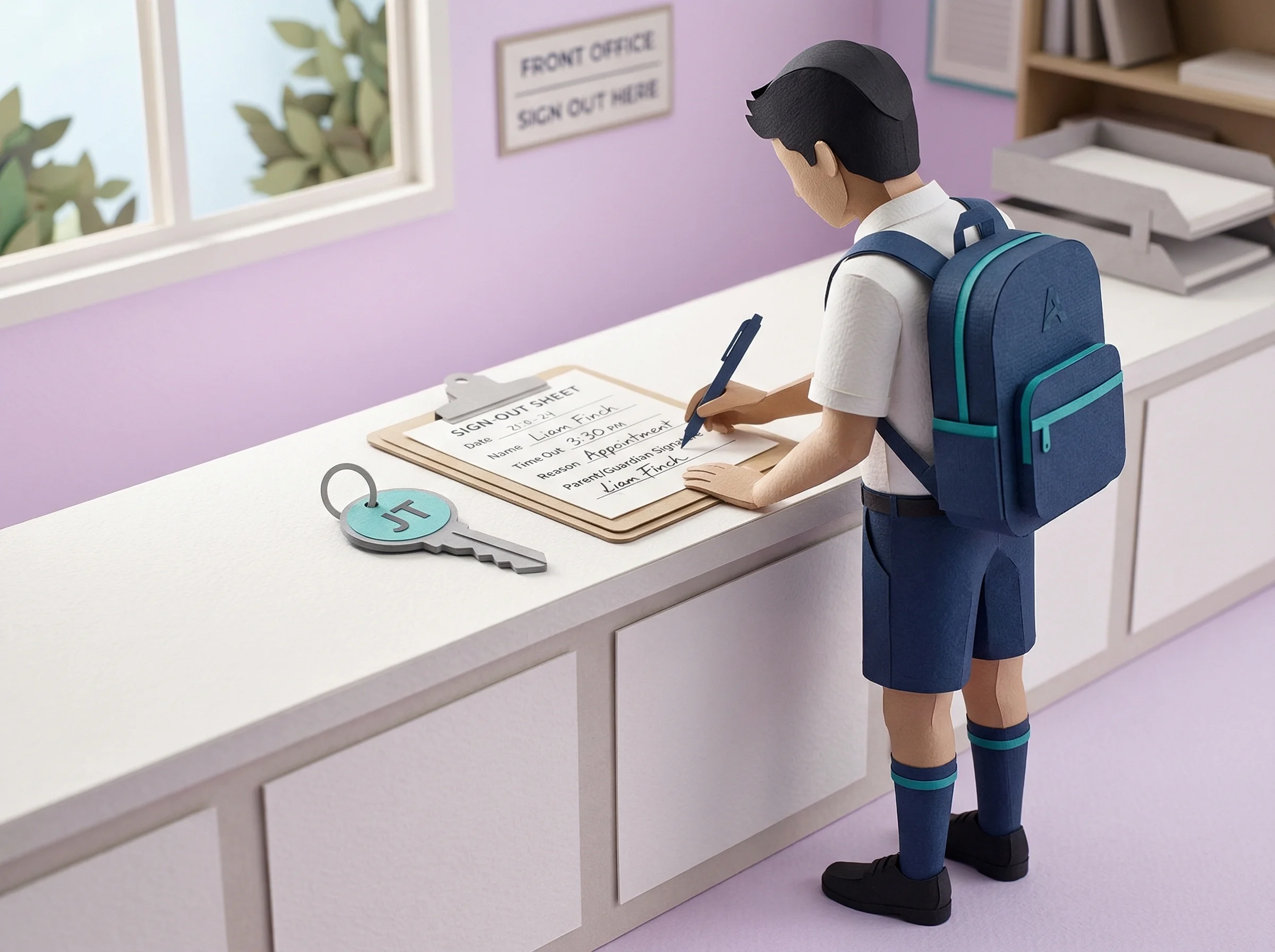
The most common step up from no shared record. Students sign their name, destination and time on a sheet attached to the classroom door or kept on the teacher's desk.
Strengths:
- Simple and familiar
- Creates some record of movement
Weaknesses:
- No timestamps (students write their own time)
- No return time recorded
- Illegible handwriting
- Sheets stay in the classroom — inaccessible to administration during emergencies
- Cannot aggregate data across the school
- Easily forged or ignored
- No shared view for authorised review
3. Digital out-of-class pass systems
A cloud-based system where teachers create digital passes when students leave class. The system records the student, teacher, selected destination, departure time, return time and duration automatically. Authorised staff can review the shared open-pass register and search completed records.
Strengths:
- Searchable records of teacher-created passes (timestamped and attributed)
- A shared open-pass register for authorised staff
- Configured workflow reminders (overdue records, staff-defined separation advisories)
- Historical reporting (record volume and recorded duration)
- Supplementary emergency context alongside rolls and headcounts
- Records for appropriate family conversations and incident reviews
- Searchable records that may support an authorised review
Weaknesses:
- Requires internet connectivity
- Per-student annual cost
- Requires a teacher workflow the school has evaluated in context
The duty of care dimension
Schools have duty-of-care and supervision responsibilities, but the applicable standard depends on jurisdiction and circumstance. Learn more about the operational questions Vero can support in school duty-of-care processes.
A timestamped pass record may help show what the school's process recorded: issuing teacher, selected destination and associated times. It does not show the student's physical location or prove that the school's measures were reasonable or compliant.
Each state has its own guidelines:
- Victoria: Duty of Care policy (Department of Education)
- NSW: Supervision guidelines (NSW Department of Education)
- Queensland: Student supervision requirements (Department of Education)
- South Australia, Western Australia, Tasmania, the ACT and the NT all have equivalent frameworks
Regardless of state, the common law standard is the same: reasonable steps, properly documented.
The emergency preparedness angle
Every school conducts lockdown and evacuation drills. But in most schools, the first question in a real emergency — "which students are not in their classroom?" — cannot be answered quickly or accurately.
With a digital pass system, authorised staff can access a central list of active passes, selected destinations, associated times and issuing teachers. The list supplements rolls, headcounts and the emergency management plan.
For principals writing annual safety reports or presenting to school councils, this is a concrete capability improvement that can be quantified and demonstrated.
The behaviour management angle
Pass records can show repeated recorded requests across a selected period. That may help an authorised team decide what context to check, but it does not prove behaviour, motive, wellbeing or physical location. Review the record alongside the school's existing support process and speak with the relevant people before drawing a conclusion.
These patterns inform:
- Parent conversations (data vs anecdotes)
- Wellbeing interventions (frequent counsellor or sick bay visits)
- Role-based review within existing support plans
- Staff-defined separation advisories with documented teacher overrides
For deputy principals who manage behaviour, this data transforms their effectiveness.
What to look for in a digital out-of-class pass system
If you're evaluating options, here's what matters for Australian schools:
- Primary hosting location plus every supporting provider, processing country and contractual safeguard
- Applicable privacy-law, policy and procurement documentation for your sector and jurisdiction
- SIS integration (ideally via Wonde for broad compatibility)
- Shared open-pass register for authorised staff
- Historical search and reporting of Vero records
- Staff-defined workflow advisories and documented overrides
- Overdue record reminders
- Role-based permissions (teachers see their classes, authorised leadership sees the agreed scope)
- Export capability for approved parent meetings and reviews
- No hardware or app installation required (browser-based)
- Fast setup (days, not weeks)
- Per-student pricing that works for Australian school budgets
Implementation considerations
A practical implementation sequence is:
- Start with a pilot group of 5-10 teachers, not a whole-school rollout
- Ask pilot teachers to share useful aspects and friction points
- Keep the staff walkthrough to 15 minutes — teachers learn by doing
- Demonstrate the workflow and invite feedback in context
- Communicate proactively with families about purpose, privacy and access
- Review participation without assuming a universal adoption target
The decision framework
For principals evaluating whether to move from paper to digital, here are the questions that matter:
- Can your school retrieve Student X's relevant pass record for 11:15am last Tuesday in under a minute?
- During an emergency, how quickly can authorised staff review open pass records alongside rolls and headcounts?
- When you meet with a family about a concern, do you have relevant records and context rather than anecdotes alone?
- If your school faced a duty-of-care review tomorrow, can you explain the purpose, limits and access controls for its records?
If the answer to any of these is "no" or "I'm not sure," it's time to consider a digital system.
Digital pass records are an operational layer across supervision, incident response and classroom routines. Evaluate the workflow against your school's baseline and requirements rather than treating software as proof of compliance.