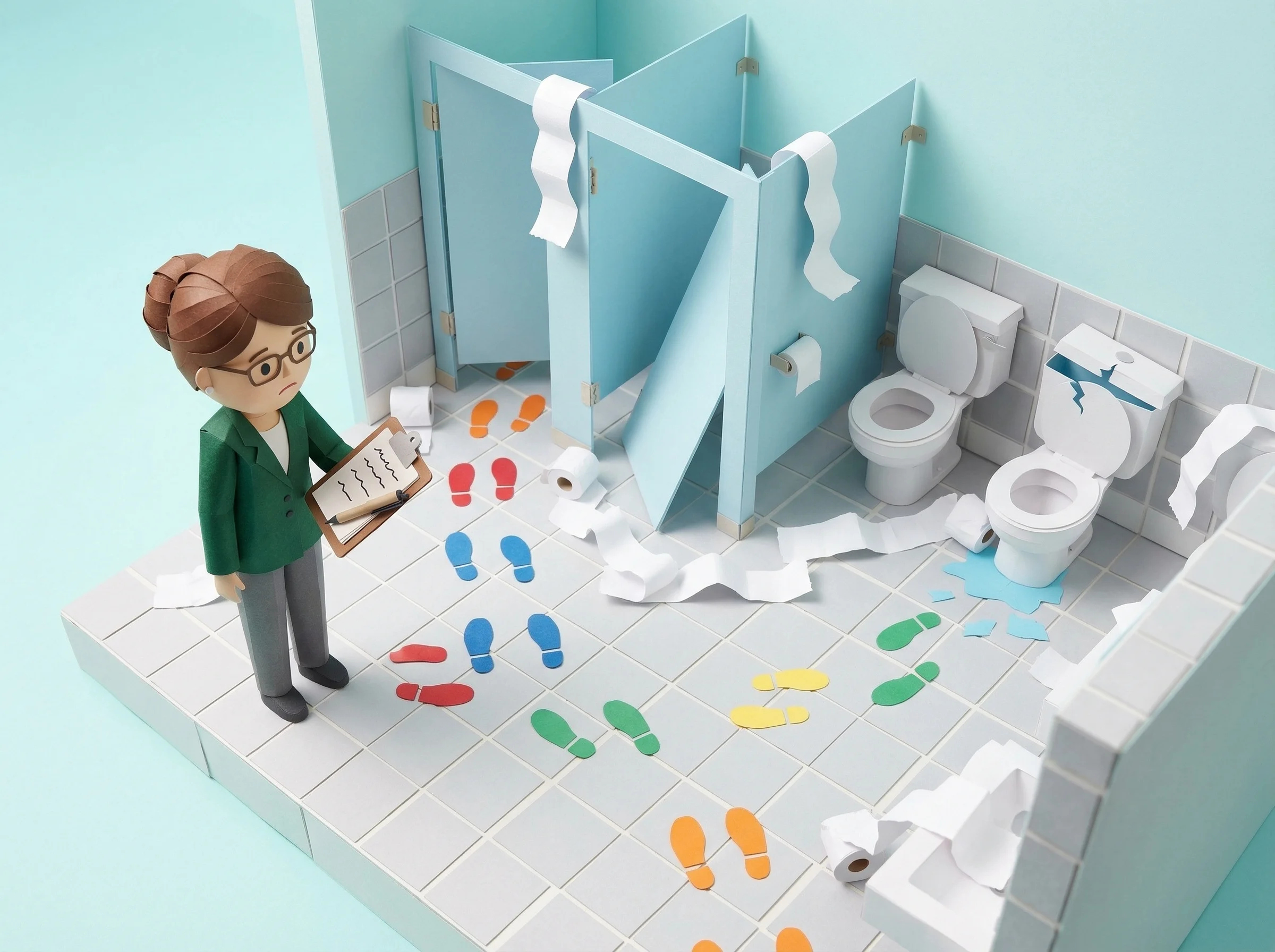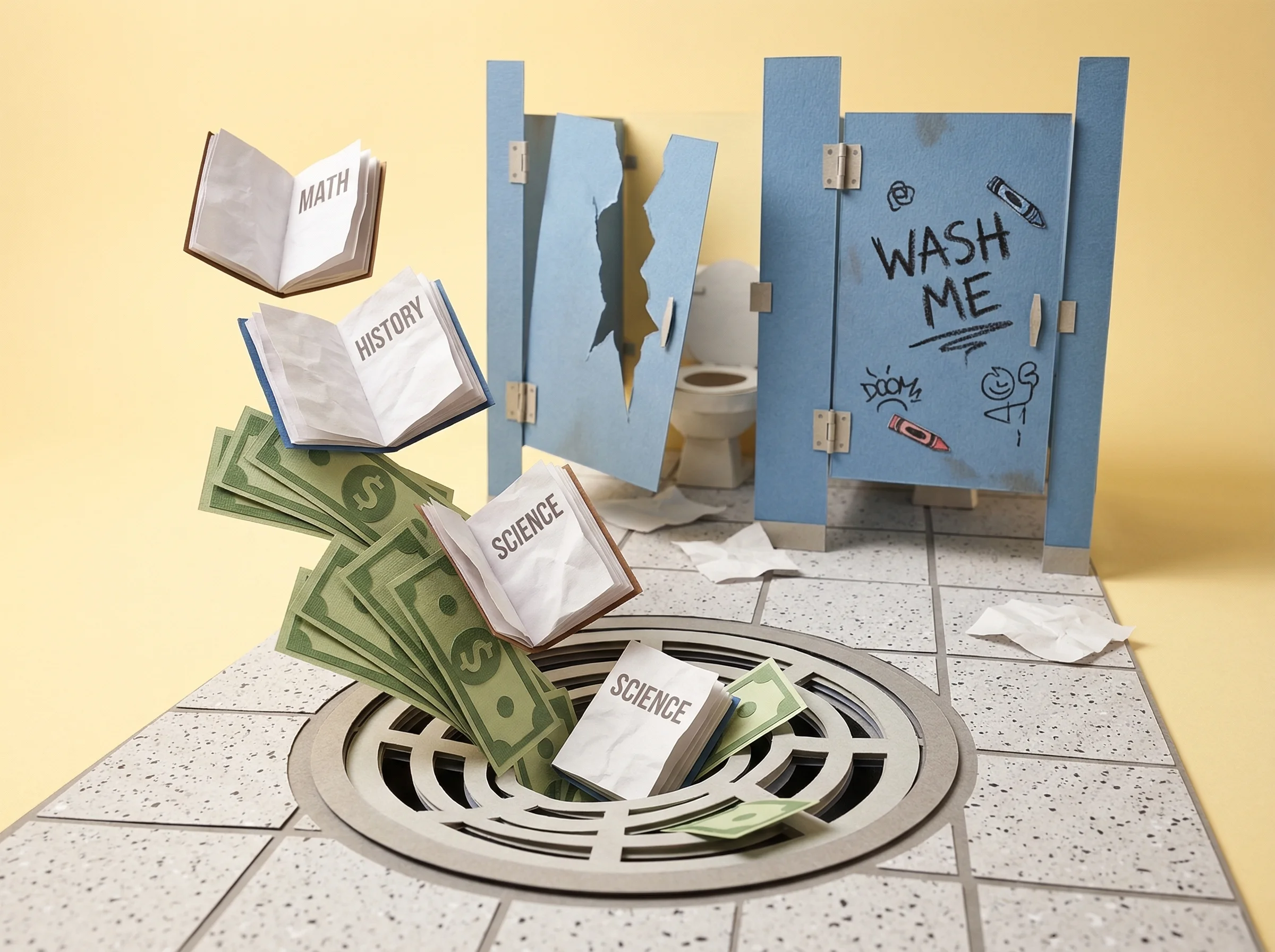
Bathroom vandalism can create repair costs, closed facilities and staff follow-up. The scale varies by school, so leaders should use their own maintenance and incident records as the baseline.
A shared movement record can add time and destination context to the school's existing incident process. It does not identify who caused damage or predict an incident.
The true cost of bathroom vandalism
The financial toll is the most visible consequence, but it is far from the only one. When a school bathroom is vandalised, the costs ripple outward in ways that are easy to underestimate.

- Repair and replacement costs. Plumbing call-outs, new fixtures, repainting — these expenses come straight from maintenance budgets that are already stretched thin. A single term of persistent vandalism can consume thousands of dollars that could have gone towards learning resources.
- Staff time spent investigating. Deputy principals and year coordinators spend hours interviewing students, reviewing timelines, and trying to piece together what happened. Without clear data, these investigations often lead nowhere.
- Impact on other students. When a bathroom is closed for repairs, every student in that wing loses access. Students with medical needs, anxiety, or other conditions are disproportionately affected. The inconvenience punishes the majority for the actions of a few.
- Erosion of school culture. Persistent vandalism sends a message that the environment is not respected — and that nobody is being held accountable. Left unchecked, it chips away at the sense of pride and belonging that schools work hard to build.
Why traditional approaches fall short
Schools have tried every conventional tool available. None of them solve the problem on their own.
CCTV cannot go inside bathrooms. Privacy legislation in every Australian state and territory prohibits cameras in bathrooms and change rooms. Schools can monitor corridors, but the moment a student walks through a bathroom door, they disappear from view. Vandals know this — and they exploit it.
Locking bathrooms punishes everyone. Some schools resort to locking facilities during lesson time, requiring students to ask for a key. This creates friction for every student who needs to use the bathroom legitimately. It generates resentment, it is a safeguarding concern for students with medical conditions, and it does little to stop determined offenders who simply wait for the bathrooms to be unlocked.
Random spot checks are resource-intensive. Sending staff to patrol bathrooms at unpredictable intervals sounds reasonable in theory. In practice, it pulls teachers away from supervision duties elsewhere, it is impossible to maintain consistently, and students quickly learn to work around the schedule.
Without data, investigations happen in the dark. When the damage is discovered — often hours after the fact — admin have no way of knowing who was in the area at the relevant time. Asking around yields inconsistent answers. Accusations without evidence damage trust. Many incidents are simply never resolved.
How pass records add context
Digital out-of-class pass systems change the equation by creating a clear, timestamped record of student movement outside the classroom. When a student leaves a lesson to use the bathroom, their teacher approves a digital pass that logs the student, the destination, and the time — both out and back.
This is not camera or GPS monitoring. It records a teacher-created pass, its selected destination and associated times. It does not verify who entered a bathroom.
After an incident, authorised staff can search for passes to the recorded destination during the relevant timeframe. The result is a starting point to review alongside maintenance timing, staff observations and student accounts, not a suspect list.
Over time, something even more powerful emerges: patterns. The same bathroom. The same period. The same small group of students. What was once invisible becomes obvious — and actionable.
Pattern analysis in practice
Consider an illustrative scenario. A school notices that damage is repeatedly discovered in the Block C bathrooms after Period 3. The numbers are examples, not a customer result.
With a digital out-of-class pass system like Vero in place, authorised staff can review pass records for Block C during Period 3 over the past four weeks. The records may show repeated selections of that destination, which gives the school a defined question to investigate alongside other evidence. They do not identify who caused damage or establish that a student entered the bathroom.
The overlapping pass records may be relevant context, but they do not place students at the scene. Staff follow the school's fair investigation process and invite each student's account.
Intervention replaces investigation. Data turns a mystery into a conversation.
A conversation may clarify the context. Schools should not assume that awareness of the record changes behaviour or that a repeated pass pattern reveals a wellbeing need.
Measure the effect; do not assume deterrence
The value of a pass record is not that it predicts an incident. It is that it can make an existing operational question easier to review after the school has defined the purpose.
A pass record changes the information available for follow-up. Whether it changes incident frequency is an outcome the school should test against its own baseline.
A digital out-of-class pass creates a searchable record of teacher-approved passes to a selected destination. That record can support fair follow-up alongside maintenance timestamps, staff observations and student accounts. It does not show who entered a bathroom, prove responsibility or guarantee a reduction in vandalism.
This distinction matters. The system does not record what students do inside a bathroom or confirm that they entered it. It records the destination selected on a teacher-created pass and associated times.
A data problem disguised as a behaviour problem
Schools have long treated vandalism as a behaviour problem — something to be addressed through consequences, supervision, and deterrence. And behaviour is certainly part of the picture. But at its core, vandalism persists because schools lack the data to understand it.
When you cannot see who was where, you cannot identify patterns. When you cannot identify patterns, you cannot intervene early. When you cannot intervene early, you are left reacting to damage after the fact — every single time.
Give authorised staff the relevant records, and they can combine them with student voice, restorative practice and facilities information. Pass records do not replace pastoral care, strong school culture or a fair incident process, and they do not show who was involved.
Pass records are one operational input to a wider facilities, supervision, behaviour and wellbeing response. Vero does not guarantee fewer incidents.
See how Vero gives authorised staff searchable pass records for fair incident follow-up.
Book a walkthrough